Node.js & NestJS development for WealthTech

Modern financial products rarely operate in isolation. We build backend systems with Node.js and NestJS for products that need to connect APIs, financial infrastructure, internal systems and complex business workflows.
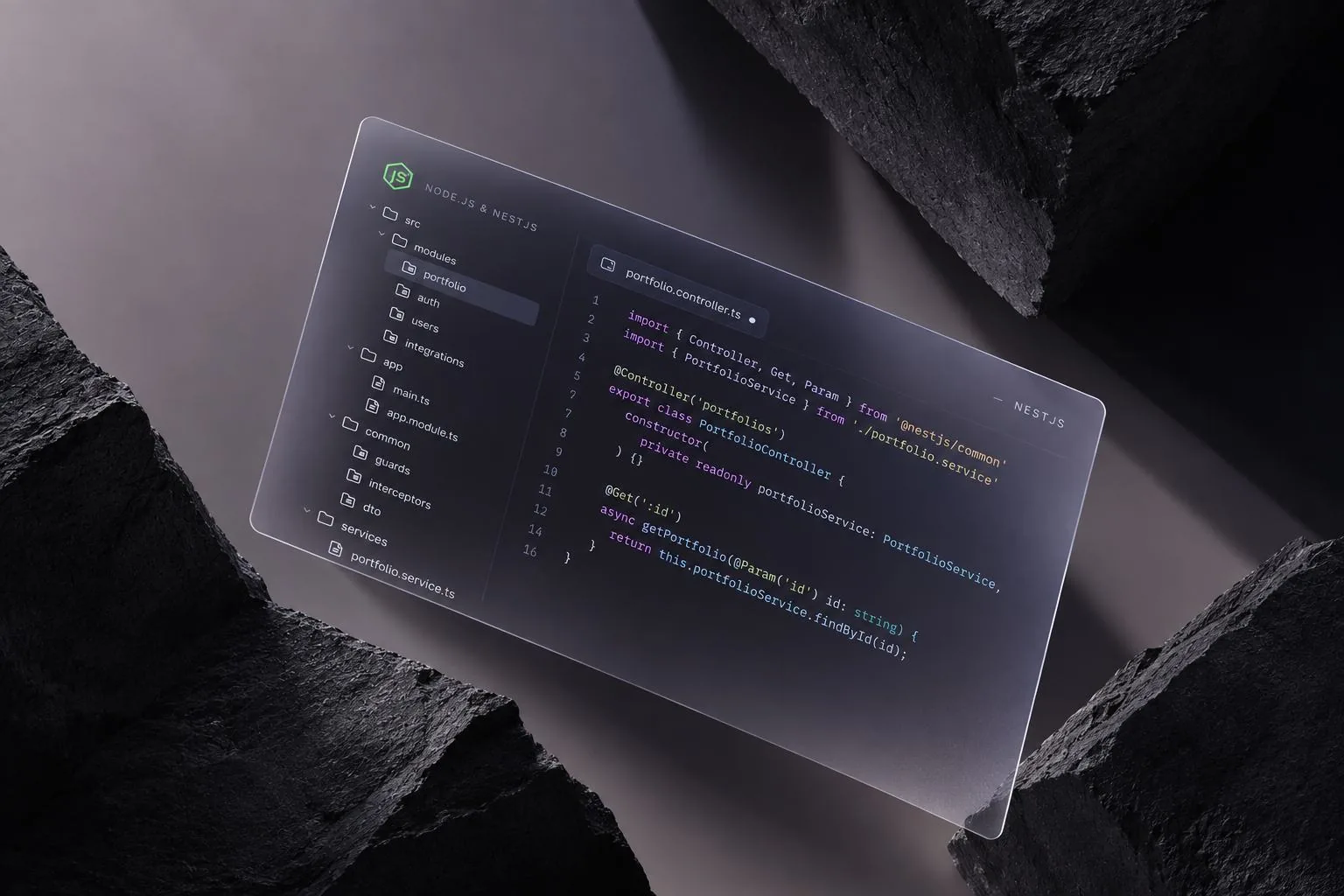
A Node.js and NestJS project open in a code editor

/technology

Why Node.js & NestJS

A structured foundation for integration-heavy products.

Financial products rarely work alone. Brokers, custodians, banks, payment providers, KYC platforms, CRMs and your own internal services all need to exchange data reliably. One failed sync can mean a wrong balance or a stuck onboarding. We use Node.js because it handles large volumes of concurrent API calls efficiently, which is exactly what integration-heavy platforms need. When a product grows complex, we add NestJS to give the backend a clear, maintainable structure.

  • /01

    Integration-ready

    Node.js is particularly well suited to applications that communicate with APIs, databases, services and external systems.

  • /02

    TypeScript across the stack

    Using TypeScript across frontend and backend creates a shared language, tooling and set of patterns across the product.

  • /03

    Structured with NestJS

    Modules, dependency injection and clear architectural patterns help complex backend systems remain understandable as products and teams grow.

  • /04

    Built for complex workflows

    From REST APIs and webhooks to background jobs, queues and real-time applications, the stack adapts to different product architectures.

/why rooftop

Why WealthTech teams choose Rooftop?

Technology is only part of the equation. We understand the products, workflows and business behind the software.

Generic Node.js agencyRooftop
Learns your business Already understands wealth management
Talks about Node.js Talks about portfolios, advisors & custodians
Builds APIs Builds the infrastructure behind financial products
General developers WealthTech-focused engineers
Delivers software Builds products

/why latam

Why U.S. companies build with Uruguay

Senior engineering talent with strong overlap with North American teams.

  • /01

    U.S. time zone overlap

  • /02

    Cultural alignment

  • /03

    English proficiency

  • /04

    Stability

  • /05

    Long-term thinking

  • /06

    Competitive rates

Map connecting Uruguay with San Francisco, New York, Europe, Brazil and Argentina
  • San Francisco UTC-7
  • New York UTC-5
  • Europe UTC+0
  • Brasil UTC-3
  • Argentina UTC-3
  • Uruguay UTC-3

/frequently asked questions

Questions CTOs ask before choosing a WealthTech engineering partner.

  • Absolutely. Some of our projects start by extending or improving existing products rather than building everything from scratch.

    We follow your architecture, coding standards, deployment process and development workflow, integrating as an extension of your engineering team from day one.

  • Both.

    Some clients need one senior Node.js engineer to accelerate delivery, while others rely on us for end-to-end product development, including product strategy, UX/UI, frontend, backend, QA and DevOps.

    We adapt to the stage of your company and your internal capabilities.

  • Yes.

    Our team has worked on products including:

    • Robo Advisors
    • Broker API integrations
    • Client Portals
    • Advisor Dashboards
    • Portfolio Reporting
    • Proposal Builders
    • Digital Onboarding
    • Investment Platforms
    • Employee Investment Benefits

    Because of that, we already understand many of the workflows, stakeholders and challenges unique to financial products in WealthTech.

  • Absolutely.

    We enjoy being involved early.

    We regularly help clients challenge assumptions, prioritize features, simplify workflows and make product decisions before a single line of code is written.

    Building the right product is just as important as building it right.

  • Yes.

    These are some of the products we’ve been focusing on over the last few years.

    We’ve worked on solutions involving portfolio reporting, advisor workflows, onboarding, proposal generation, internal operations and client-facing platforms for wealth management firms.

  • Financial software requires a different level of discipline.

    We design systems with privacy, least-privilege access, auditability and secure development practices in mind. We also understand that every firm and startup has its own compliance requirements and we adapt our approach accordingly.

    When using AI, we work with each client to define appropriate data handling policies and security boundaries.

  • Yes.

    Whether your backend needs a Node.js version upgrade, a migration to NestJS, improved performance or a complete re-architecture, we can help modernize it incrementally without disrupting your business.

  • We believe maintainability is a product feature.

    Our projects emphasize clean architecture, code reviews, automated testing where appropriate, documentation and scalable engineering practices that allow teams to move faster over time.

  • We’re based in Uruguay, giving us strong timezone overlap with North America.

    Our team works daily with tools like ClickUp, Slack, GitHub, Jira, and Figma, integrating naturally into distributed engineering organizations.

    Communication is part of the job, not an afterthought.

  • Because technology is only part of the equation.

    Building products for wealth management requires understanding advisors, client relationships, reporting, onboarding, portfolio workflows, financial operations and regulatory constraints.

    We combine that industry understanding with strong engineering capabilities, allowing us to contribute from day one instead of spending months learning your business.

  • Financial platforms are systems that handle a lot of integrations: custodians, market data, KYC providers, CRMs, etc. Node.js is well suited for this kind of work and it can handle many concurrent requests and API calls efficiently. In addition to this, leveraging TypeScript on both the frontend and backend lets them share the types and validations which translate to fewer integration bugs and better developer experience working across the stack.

  • We use NestJS, a TypeScript framework on top of Node.js, to build most backends. It facilitates a maintainable codebase as the scope and team grow because of its opinionated architecture (modules, dependency injection, guards, validations). We implement stateless APIs that scale horizontally, with caching, queues for background jobs and rate limiting.

  • Yes. Node has the ability to handle thousands of open connections with effectiveness, which makes it a natural fit for WebSockets and server-sent events. Some typical use cases are: live portfolio valuations, market data streams, alerts and transaction status updates.

/our tech stack

Here’s the technology we use.

  • /01

    Frontend

    • React
    • Next.js
    • TypeScript
  • /02

    Backend

    • Node.js
    • NestJS
    • Python
  • /03

    Database

    • PostgreSQL
    • MongoDB
  • /04

    Infrastructure

    • AWS
    • Cloudflare
    • CI/CD